Choose appliance or general-purpose Linux
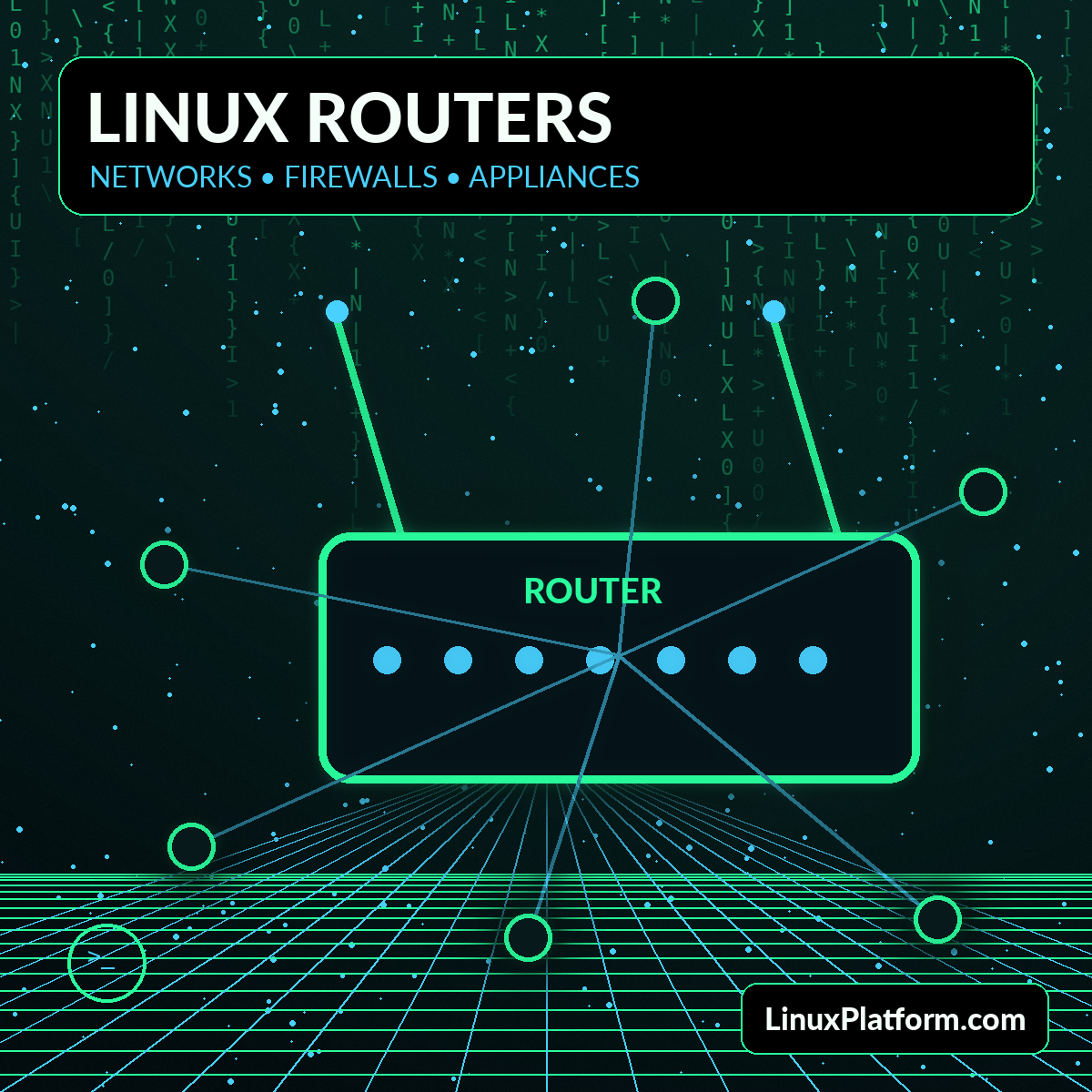
Purpose-built distributions provide integrated configuration and appliance-style upgrades. General Linux offers custom automation and services but requires the team to assemble persistence, firewall, routing, VPN, monitoring, and recovery. Avoid two competing configuration systems.
Select hardware based on packet rate, encryption, inspection, interface drivers, queues, cooling, storage endurance, console access, and replacement logistics. Test small packets and real tunnel workloads, not only headline bandwidth.
Model zones and policy
Define internet, user, server, management, guest, and transit zones. VLANs segment traffic; firewall and routing policy enforce trust. Separate policy for traffic addressed to the router from traffic forwarded through it.
Use default-deny rules, narrow management access, documented routes, protected DNS and DHCP, and deliberate IPv6 behavior. Keep a diagram aligned with the active configuration.
Operate routing and VPNs safely
Use static or dynamic routing according to topology. Apply authentication, prefix filters, and route limits. Design remote changes with commit confirmation or timed rollback so a lost session does not strand a site.
Treat VPNs as identity, key rotation, routing, DNS, and revocation systems—not only encryption. Monitor handshake age, tunnel traffic, latency, and route availability.
Observe and recover
Collect interface errors, drops, packet rate, bandwidth, CPU, memory, storage, temperature, route changes, tunnel status, and service health. Export logs and metrics away from the router with bounded local retention.
Back up configuration automatically, test upgrades in a lab, and rehearse failover or cold-spare restoration. A reliable Linux router forwards intended traffic predictably and can be changed without gambling on remote access.